

An aircraft mechanic inspects, repairs, and overhauls aircraft, then records the work that returns each one to service. The credential behind the job is the FAA mechanic certificate with Airframe and Powerplant ratings, known as the A&P. The Bureau of Labor Statistics puts the median wage for aircraft mechanics and service technicians at $79,870 a year (OEWS, May 2025).
Already sure you want in? Go straight to our step-by-step guide on how to become an aircraft mechanic.
What Does an Aircraft Mechanic Do?
An aircraft mechanic keeps aircraft airworthy. O*NET, the Labor Department's occupation database, sums up the job as diagnosing, adjusting, repairing, or overhauling aircraft engines and assemblies such as hydraulic and pneumatic systems. But the task it ranks first isn't a repair. It's inspecting completed work to certify that the maintenance meets standards and the aircraft is ready for operation.
That's the part people underestimate. Your signature in the maintenance record puts an airplane back in service, so much of the aircraft mechanic job is reading, checking, and writing things down.
Core Aircraft Mechanic Duties
These are the aircraft mechanic duties O*NET ranks highest (49-3011.00, updated 2026):
- Inspect completed work to certify that maintenance meets standards and the aircraft is ready to fly.
- Read and interpret maintenance manuals, service bulletins, and other specifications to decide how to repair or replace a component.
- Keep repair logs that document all preventive and corrective maintenance.
- Examine landing gear, hydraulic systems, deicers, and other components for cracks, breaks, and leaks.
- Conduct the routine and special inspections that regulations require.
Further down the list: finding hidden cracks with x-ray and magnetic inspection equipment, pulling engines with hoists, and measuring control cable tension.
What a Shift Looks Like
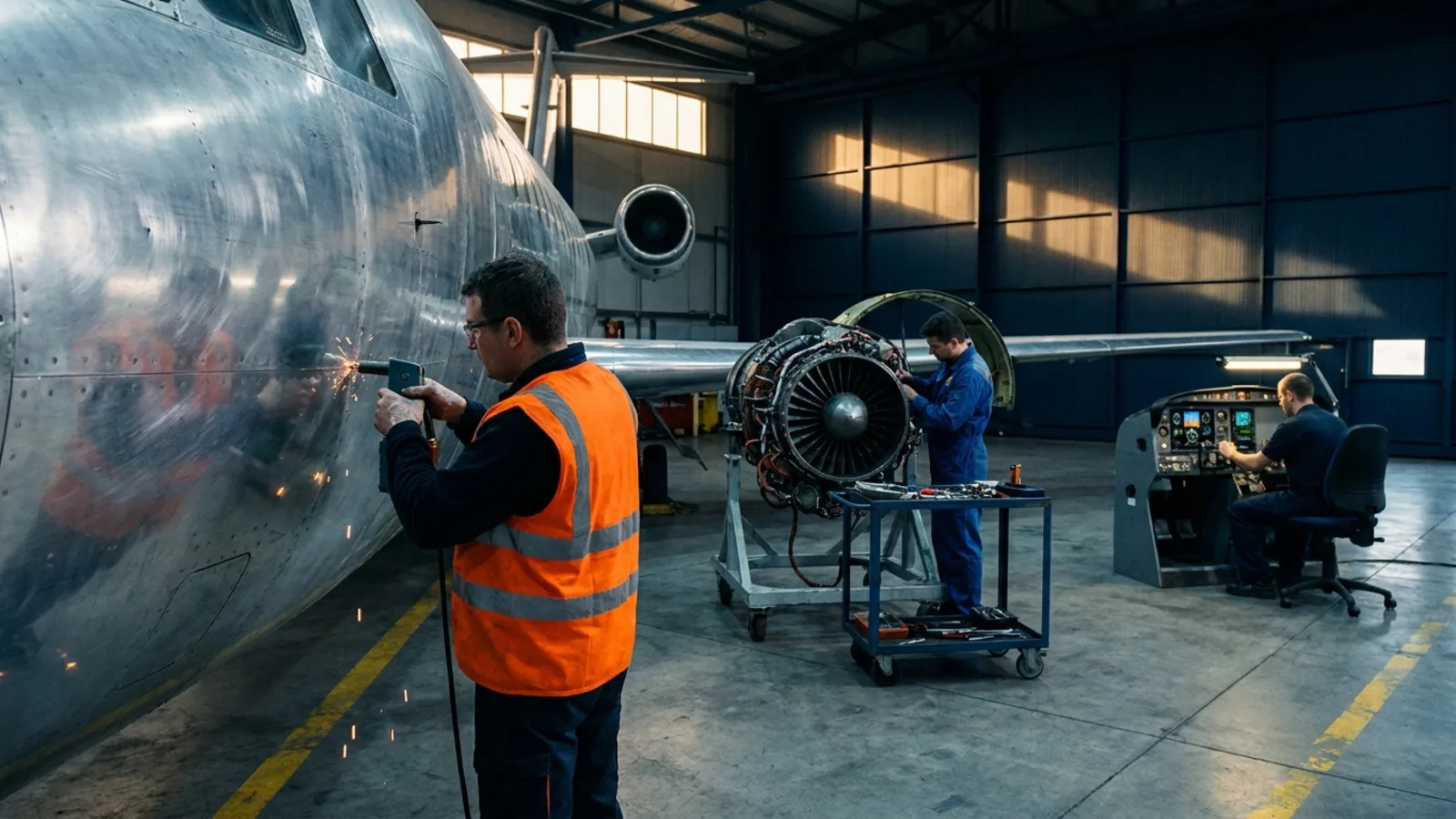
Picture a morning on the flight line. A pilot's write-up says an engine ran rough on climb, so you read it, pull the manual, and start troubleshooting (O*NET lists exactly that task). Later you might be on a ladder inspecting a wing, then closing out the logbook entry.
It's loud and physical. In O*NET's work context survey, 76% of aircraft mechanics report uncomfortable noise every day, and 72% work daily indoors in space that isn't climate controlled. And 77% rate being exact as extremely important.
Airplane Mechanic, Aviation Mechanic, AMT: One Occupation
O*NET's reported job titles include aircraft mechanic, airframe and powerplant mechanic, aviation maintenance technician (AMT), aviation mechanic, and helicopter mechanic. The FAA calls the credential the Aviation Mechanic certificate, and BLS counts everyone under Aircraft Mechanics and Service Technicians (SOC 49-3011). So an airplane mechanic posting and an aviation maintenance technician posting describe the same work.
Aircraft Mechanic Specialties: Airframe, Powerplant, Avionics, and Inspection
The FAA issues one mechanic certificate with an Airframe rating, a Powerplant rating, or both, and it doesn't issue specialist ratings for work like welding or electronics (FAA). Specialties come from your ratings, your aircraft, and credentials you add later.
| Specialty | What You Work On | Credential |
|---|---|---|
| Airframe | Structures, landing gear, hydraulics, and airframe systems, including the 100-hour inspection on an airframe. | FAA Airframe rating |
| Powerplant | Engines and propellers, including the 100-hour inspection on a powerplant or propeller. | FAA Powerplant rating |
| Avionics | Aircraft electronics, which certificated airframe mechanics may work on. | No FAA avionics rating. Optional: FCC GROL, ASTM NCATT AET |
| Inspection | Annual inspections and sign-off after major repairs or alterations. | Inspection Authorization (both ratings held 3+ years) |
One limit applies to every certificated mechanic: the certificate doesn't cover major repairs or major alterations to propellers, or any repair or alteration of instruments (14 CFR Part 65).
Avionics is where people get confused. The FAA says there's no avionics-specific certification, and certificated airframe mechanics may work on avionics equipment. Optional credentials include the FCC General Radiotelephone Operator License and the ASTM NCATT Aircraft Electronics Technician exam, covered in our avionics certifications guide.
Inspection is the senior specialty. An Inspection Authorization requires both ratings held for at least three years, two years of active maintenance work, and a written test. An IA can approve an aircraft for return to service after a major repair and perform annual inspections. Helicopter work is a specialty by aircraft, not rating. See the helicopter mechanic career profile.
Where Do Aircraft Mechanics Work?
BLS counted 138,090 aircraft mechanics and service technicians in May 2025. Three industries hold most of them: support activities for air transportation, scheduled airlines, and aerospace manufacturing. Together they account for 96,970 jobs, or 70.2% of the total (96,970 ÷ 138,090).
| Industry | Jobs | Share of All Jobs | Median Wage |
|---|---|---|---|
| Support Activities for Air Transportation | 42,580 | 30.8% | $72,910 |
| Scheduled Air Transportation | 29,480 | 21.3% | $98,300 |
| Aerospace Product and Parts Manufacturing | 24,910 | 18% | $82,720 |
| Federal Executive Branch | 12,240 | 8.9% | $76,210 |
| Nonscheduled Air Transportation | 6,420 | 4.6% | $80,180 |
| Couriers and Express Delivery Services | 3,980 | 2.9% | $90,190 |
The federal executive branch employs 12,240 aircraft mechanics, and couriers and express delivery services employ 3,980. Weighing military service as a way in? See our military aircraft mechanic guide.
Certificate rates differ by setting. The 2025 ATEC/Oliver Wyman Pipeline Report cites FAA figures showing certificated mechanics make up 61% of the air operator maintenance workforce, 22% of the repair station workforce, and 86% of the general aviation maintenance workforce.
States With the Most Aircraft Mechanic Jobs
Texas, Florida, and California lead on headcount. Browse aviation maintenance schools by state to find training near those jobs.
How Much Does an Aircraft Mechanic Make?
The median aircraft mechanic salary was $79,870 in May 2025, or $38.40 an hour (BLS OEWS). The bottom 10% earned under $48,780, and the top 10% earned more than $128,890.
Industry moves the number a lot. Scheduled airlines paid a median of $98,300, while support activities for air transportation paid $72,910. That's a $25,390 gap ($98,300 minus $72,910) inside the same occupation.
State matters too. New Jersey's median was $105,370 and Washington's was $98,980, against $61,250 in Idaho. See the aircraft mechanic salary guide for every state and metro, and the airline mechanic salary guide for carrier pay.
How to Become an Aircraft Mechanic
The FAA recognizes two ways to qualify for the mechanic certificate: training at an FAA-approved aviation maintenance technician school or documented on-the-job experience. Military maintenance experience can also earn credit. Here's the route in order.
-
Meet the Basic Requirements
Be at least 18 and able to read, write, speak, and understand English. No medical certificate is required, though most FAA-approved schools require a high school diploma or GED.
-
Train at an FAA-Approved School or Log Experience
School takes 18 to 24 months. Without school, you need 18 months of documented experience for one rating or 30 months for both.
-
Pass the Knowledge Tests
General, Airframe, and Powerplant, each passed at 70% or better before the oral and practical tests.
-
Pass the Oral and Practical Tests
A Designated Mechanic Examiner tests you against the Aviation Mechanic Airman Certification Standards. All tests must be passed within 24 months.
-
Receive Your Mechanic Certificate
The FAA charges no fee to issue it.
Program length varies by school. Gordon Cooper Technology Center in Shawnee, Oklahoma, lists an 18-month, 1,920-clock-hour course. The Pittsburgh Institute of Aeronautics Youngstown campus lists 16 months and 1,900 clock hours. Guilford Technical Community College in North Carolina lists six semesters for both ratings.
The ATEC Pipeline Report found two-thirds of new mechanics certified through an aircraft mechanic school, 14% through military experience, and 20% through civilian work experience. Our guides cover aircraft mechanic school cost, aircraft mechanic apprenticeships, the military route, and online aircraft mechanic school options.
Is it hard? Of original mechanic certificate applicants tested by an FAA-designated examiner in 2025, 74.6% were approved (11,065 of 14,838), according to FAA Civil Airmen Statistics. Our guide to the FAA mechanic exams breaks down each test.
Aircraft Mechanic Certification: What It Lets You Do
A certificated aircraft mechanic can perform or supervise maintenance and alterations on what the ratings cover. The Airframe rating lets you approve an airframe for return to service after work you performed, supervised, or inspected, excluding major repairs and major alterations. The Powerplant rating does the same for engines and propellers.
Two rules come with it. You can't sign off a type of work you haven't performed satisfactorily before. And to stay current, you need at least six months of mechanic or supervisory work within the past 24 months, or an FAA finding that you can do the work.
Can you work without the certificate? Yes, under supervision. 14 CFR 43.3(d) lets you work under a certificated mechanic who personally observes the work and is readily available in person. It doesn't authorize required inspections or the inspection after a major repair. More in our mechanic license guide.
Aircraft Mechanic Job Outlook
Projections Central 2024-2034; FAA Civil Airmen Statistics 2025
Projected Jobs, 2034
145,000
Growth, 2024-2034
4%
Openings per Year
11,300
New Mechanic Certificates, 2025
11,103
Projections Central expects aircraft mechanic employment to grow from 139,400 in 2024 to 145,000 in 2034, a 4% gain. That's modest. Growth works out to about 560 jobs a year (5,600 ÷ 10), so most of the 11,300 projected annual openings come from existing jobs turning over.
Industry groups see a tighter market. ATEC's 2025 Pipeline Report projected a 10% shortage of certificated mechanics in 2025 from commercial air transport demand, narrowing to 7%, about 10,000 mechanics, by 2035. Supply is rising too: the FAA issued 11,103 original mechanic certificates in 2025, up from 9,013 in 2024.
None of that promises a job in a particular city. See our aircraft mechanic jobs guide for where the positions are.
Pros and Cons of Being an Aircraft Mechanic
Pros
- The FAA sets no degree requirement and requires no medical certificate.
- A $79,870 national median, and $98,300 at scheduled airlines.
- The federal certificate doesn't expire and isn't tied to one state.
- A clear next step: Inspection Authorization after three years with both ratings.
Cons
- Noise and grime: 76% report uncomfortable noise daily, and 63% are exposed to contaminants daily (O*NET).
- Physical work at height: 43% spend about half their time on ladders, scaffolds, or poles.
- 42% report exposure to hazardous conditions every day, and 41% work outdoors in all weather at least once a week.
- Pay spreads wide: the 10th percentile is $48,780.
Frequently Asked Questions
What Does an Aircraft Mechanic Do?
What Does A&P Mean for an Aircraft Mechanic?
How Long Does It Take to Become an Aircraft Mechanic?
Can You Make $200k as an Aircraft Mechanic?
Is It Hard to Become an Aircraft Mechanic?
Are Aircraft Mechanics in Demand?
Sources
- 49-3011.00 Aircraft Mechanics and Service Technicians
- 53-6051.07 Transportation Vehicle, Equipment and Systems Inspectors, Except Aviation
- BLS Occupational Employment and Wage Statistics, May 2025
- Projections Central, State Occupational Employment Projections 2024-2034
- 14 CFR Part 65, Subpart D: Mechanics
- 14 CFR 43.3: Persons Authorized to Perform Maintenance
- Become an Aviation Mechanic
- Experience Requirements to Become an Aircraft Mechanic
- How to Become an Aviation Maintenance or Avionics Technician
- U.S. Civil Airmen Statistics, 2025
- New Mechanic Certificates Jumped in 2024, but Technical Workforce Gap Concerns Remain (2025 Pipeline Report)
- 47 CFR Part 13: Commercial Radio Operators
- NCATT Certification
- Aviation Maintenance Technology
- Youngstown Campus
- Aviation Systems Technology
All sources retrieved .
How we pick and check sources is explained on our methodology page.