
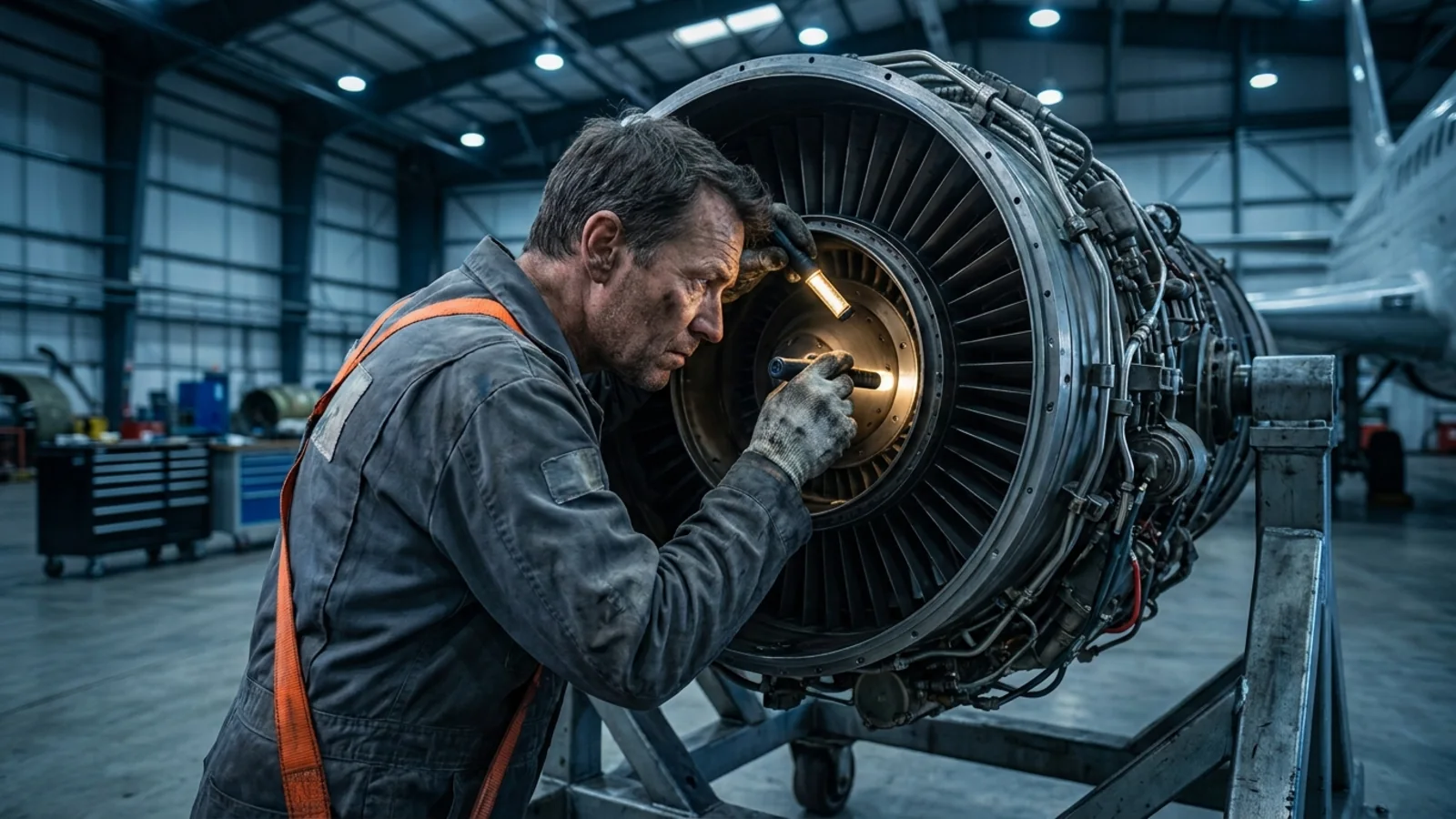
An A&P license is the FAA mechanic certificate with both Airframe and Powerplant ratings: A for Airframe, P for Powerplant. To earn it, you must be 18, read, write, speak, and understand English, qualify through an FAA-approved (Part 147) aircraft mechanic school or 30 months of documented experience, and pass the written, oral, and practical tests within 24 months, according to 14 CFR 65.71 and 65.77.
Original Certificates Issued, 2025
11,103
FAA Civil Airmen Statistics 2025
FAA-Approved Schools
225
FAA AVInfo, retrieved Sep 2026
Written Test Passing Score
70%
FAA, Become an Aviation Mechanic
Aircraft Mechanic Median Pay
$79,870
BLS OEWS, May 2025
What an A&P License Is
The FAA doesn't use the word license. It issues an Aviation Mechanic certificate under 14 CFR Part 65, and that one certificate can carry an Airframe (A) rating, a Powerplant (P) rating, or both. When you hold both, the FAA says it's "commonly referred to as an A&P Certificate." Most people call it an A&P license (or A and P license), and both names mean the same credential.
You don't have to earn both ratings. You can hold one and add the other later, as long as you pass the new rating's tests within 24 calendar months. Holding both is what lets the airframe and powerplant certificate cover the whole aircraft: structures and systems on one side, engines and propellers on the other.
A few things surprise people. The FAA doesn't require a medical certificate to hold the A&P license. It doesn't issue specialist ratings for welders, avionics, or ground equipment.
And a mechanic license from another country doesn't substitute for it: you still have to meet FAA eligibility and pass the FAA tests. Once you have the certificate, 14 CFR 65.89 says you keep it near where you work and show it to the FAA, the NTSB, or law enforcement on request.
What the A&P License Lets You Do
Under 14 CFR 65.81, a certificated mechanic may perform or supervise maintenance, preventive maintenance, and alterations on the aircraft and parts they're rated for. Two exclusions are written right into the rule: major repairs and major alterations of propellers, and any repair or alteration of instruments.
The rule also limits you to work you've done before. If you haven't performed a task at an earlier date, you can't supervise it or sign it off until you show you can, either to the FAA's satisfaction or under the direct supervision of an experienced mechanic or repairman. And you can't use the certificate on a job unless you understand the current manufacturer instructions and maintenance manuals for it.
Each rating adds return-to-service authority. With the Airframe rating (65.85), you can approve an airframe or related part for return to service after performing, supervising, or inspecting the work, and you can do the Part 91 100-hour inspection on the airframe. The Powerplant rating (65.87) gives the same authority for engines and propellers. Neither rating covers major repairs or major alterations, apart from a 2025 allowance for certain light-sport aircraft.
What Requires an Inspection Authorization
Some signatures belong only to mechanics who also hold an Inspection Authorization (IA). Under 65.95, an IA holder can approve an aircraft for return to service after a major repair or alteration done with FAA-approved data, and can perform annual inspections and perform or supervise progressive inspections.
| Task | Certificated Mechanic | Mechanic With IA |
|---|---|---|
| Perform or supervise maintenance and alterations you are rated for | Yes | Yes |
| Approve return to service after routine work you performed or inspected | Yes | Yes |
| 100-hour inspection (Part 91) | Yes | Yes |
| Return to service after a major repair or major alteration | No, except certain light-sport aircraft | Yes, with FAA-approved data |
| Annual inspection | No | Yes |
| Progressive inspection | No | Perform or supervise |
| Perform a major propeller repair or alteration, or any instrument repair or alteration | No | No |
A&P License Requirements and Eligibility
The eligibility list in 14 CFR 65.71 is short. You must be at least 18 years old. You must be able to read, write, speak, and understand English. The one exception is for applicants employed outside the U.S. by a U.S. air carrier, whose certificate is endorsed "Valid only outside the United States." And you must pass all of the required tests within a 24-month period.
The FAA sets no education requirement for the A&P license itself. But most aircraft mechanic schools ask for a high school diploma or GED before you enroll, and some employers want one too. So if you're planning the school route, treat the diploma as a practical requirement even though the regulation doesn't list it.
Three Routes to the Airframe and Powerplant Certificate
Before you can test, you have to show the FAA you're qualified to test. There are three ways to do that: graduate from an FAA-approved school, document civilian work experience, or document military maintenance experience. The 2025 ATEC Pipeline Report found about two-thirds of new mechanics came through an aircraft mechanic school, 20 percent through civilian work experience, and 14 percent through the military.
| Route | Who It Fits | Minimum Time | Documentation |
|---|---|---|---|
| FAA-approved school | Career starters and changers who want structured training and the earliest test dates | No FAA-set hours since 2022. The FAA estimates 18 to 24 months | Authenticated graduation document from the school |
| Civilian experience | People already working at a repair station, FBO, or maintenance shop, including apprentices | 18 months for one rating, 30 months for both, full-time | Pay receipts or supervisor-signed logs with hours, tasks, and aircraft registration numbers, plus Form 8610-2 signed by an FAA inspector |
| Military experience | Service members and veterans who worked in an aviation maintenance specialty | 18 or 30 months of time working in the specialty, not training time | DD Form 214, evaluation records, and a letter from your Executive or Classification Officer, plus Form 8610-2 signed by an FAA inspector |
FAA-Approved School
An FAA-approved school is the only route with no fixed calendar minimum in the regulation. You finish the curriculum, the school gives you an authenticated completion document, and you're eligible to test.
You also skip the inspector review of Form 8610-2 that experience applicants need. There are 225 FAA-approved schools in the FAA's current list, and you can compare aircraft mechanic schools by state or read how we rank aircraft mechanic schools.
Civilian Work Experience
Under 65.77, you need at least 18 months of practical experience for one rating, or 30 months doing the duties of both at the same time for the full A&P license. The FAA measures it on a 40-hour week, so overtime doesn't shorten the calendar.
Only time actually performing maintenance counts. Work as a non-certificated mechanic at a repair station qualifies, and an aircraft mechanic apprenticeship is one structured way to build it.
Military Experience
Serving isn't enough by itself. The FAA says you won't be authorized to test just because you served, and training time doesn't count. The Joint Service Aviation Maintenance Technician Certification Council (JSAMTCC) evaluates military specialties to decide what credit the FAA may grant. Eligible service members, dependents, retirees, and DoD and DHS civilians can take the knowledge tests at no cost. See our military aircraft mechanic guide for branch details.
How the 2022 Part 147 Rule Changed School Hours
If you've read that aircraft mechanic school takes 1,900 hours, that number is out of date. Before 2022, Part 147 set fixed minimums: 1,150 hours for a single rating (400 general plus 750 rating hours) and 1,900 hours for both (400 general plus 750 airframe plus 750 powerplant). The FAA published a rewrite on May 24, 2022, and it took effect September 21, 2022.
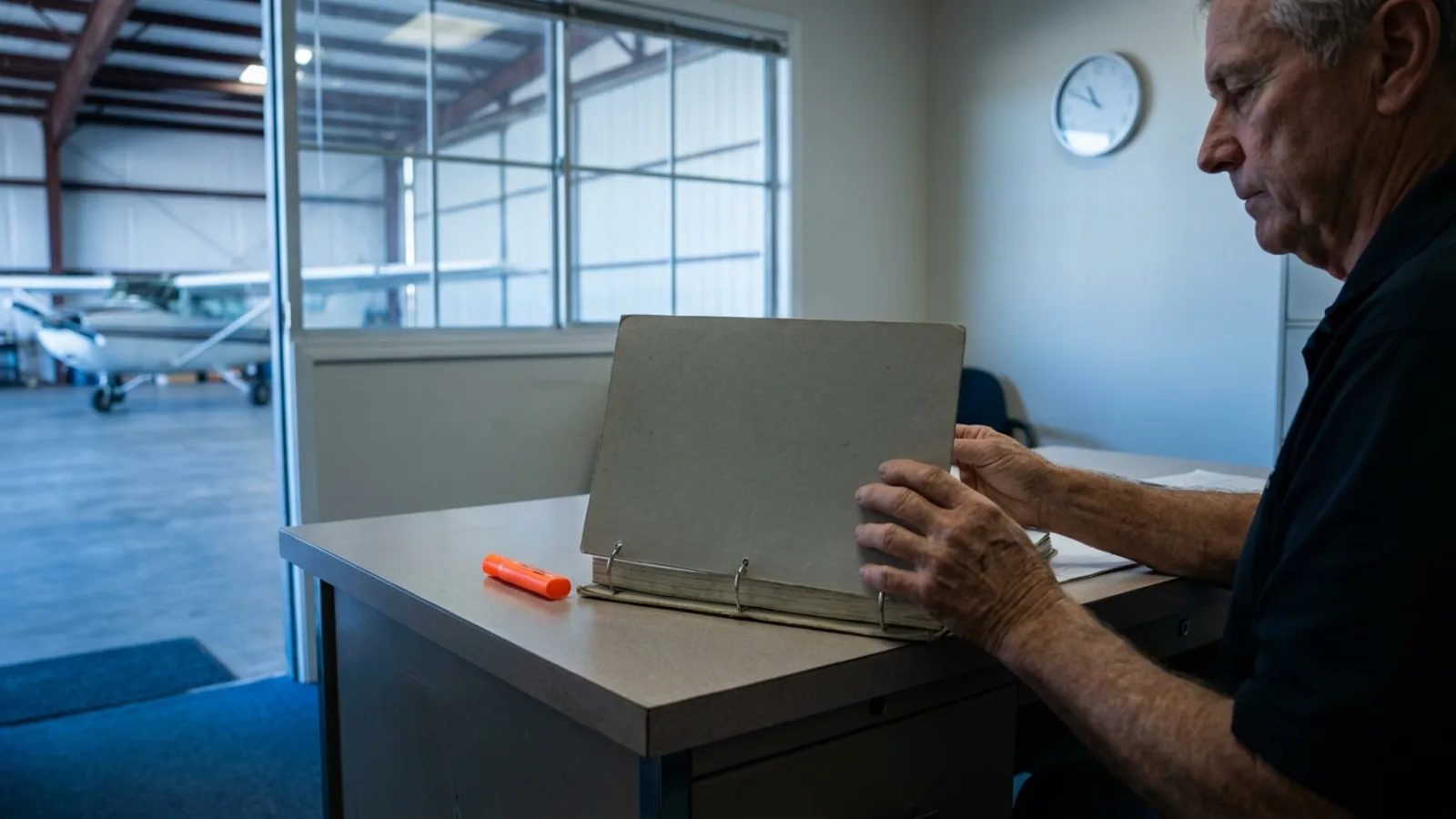
Current Part 147 drops the hour count. Each school must keep a curriculum "designed to continually align with" the mechanic Airman Certification Standards, keep shop classes at 25 students per instructor or fewer, and hold a pass rate of at least 70 percent over three years for graduates who test within 60 days. The school is judged on what its students can pass, not on seat time.
That's why published program lengths now vary so much. University of Alaska Fairbanks lists a 12-month program. San Joaquin Valley College says its certificate takes as few as 14 months. West-MEC in Arizona still publishes 1,926 clock hours over about two and a half years. For more, see how long aircraft mechanic school takes.
The A&P Tests: Written, Oral, and Practical
Every applicant for the A&P license takes three kinds of test for each rating: a written knowledge test, an oral test, and a practical test. The knowledge side has three exams: General, Airframe, and Powerplant. Here's the sequence the FAA lays out.
-
Get an FAA Tracking Number
Register for an FTN in IACRA before you schedule a knowledge test. The mechanic application itself still uses paper forms.
-
Show You Qualify
School graduates present their completion document. Experience applicants take Form 8610-2 to an FAA inspector at a FSDO for review and signature.
-
Pass the Knowledge Tests
Take the General, Airframe, and Powerplant tests at an approved testing center. You get up to two hours for each and need 70 percent to pass.
-
Pass the Oral and Practical
A Designated Mechanic Examiner questions you and watches you perform tasks drawn from the ACS for each rating.
-
Receive Your Certificate
Once every test is passed, the FAA issues the mechanic certificate with the ratings you earned, at no charge for issuance.
Order matters. You must pass each section of the written test before applying for the oral and practical. Students at FAA-approved schools get two head starts: you can take the General written once the school certifies you finished the general portion, and a school can clear you for the oral and practical during your final subjects.
All tests must fall within 24 months, per 65.71. If you already hold one rating and add the other, you have 24 calendar months to pass that rating's tests. A narrow exception in 65.75(d) and 61.40 lets people who were deployed outside the U.S. in support of Armed Forces operations test on an expired written report.
Fail a test and you can retest after 30 days, or sooner with a signed statement of additional instruction.
The Airman Certification Standards (FAA-S-ACS-1)
The tests follow FAA-S-ACS-1, the Aviation Mechanic General, Airframe, and Powerplant Airman Certification Standards. The document is dated November 2021, and the FAA lists it as effective September 21, 2022, the same day the new Part 147 took effect. The FAA says tests after July 31, 2023 are based on the ACS rather than the older Practical Test Standards.
The ACS splits the material into 40 subject areas: 12 General, 15 Airframe, and 13 Powerplant (12 + 15 + 13 = 40). General runs from electricity and electronics through human factors. Airframe runs from metallic structures through water and waste systems. Powerplant runs from reciprocating engines through propellers.
The FAA also publishes a companion guide, FAA-G-ACS-1, now with two changes. Schools build their curriculums to this document, so it's the best study map you'll get.
Keeping Your A&P License Current
The A&P license doesn't expire. It stays valid until it's surrendered, suspended, or revoked. But holding the certificate and being allowed to use it are different things.
Under 14 CFR 65.83, you can't exercise the privileges unless, within the preceding 24 months, the FAA found you able to do the work, or you spent at least 6 months serving as a mechanic, technically supervising other mechanics, or supervising maintenance in an executive role. If you leave the hangar for a few years, plan on rebuilding recent experience before you sign anything off.
What the A&P License Costs
The FAA charges nothing to issue the mechanic certificate. The costs come before that. The knowledge tests are given at commercial testing centers for a fee, and the Designated Mechanic Examiner charges for the oral and practical. Cuesta College in California lists $175 per written test and $800 to $1,200 per rating for the practical, and estimates total FAA testing at $2,400 to $3,125.
Tuition is the bigger number, and it swings from community-college unit fees to private-school program prices. Our aircraft mechanic school cost guide breaks down published prices by school, with the period each price covers.
How Many People Hold an A&P License
The FAA estimated 348,426 active mechanic certificates on December 31, 2025, up from 337,855 a year earlier. That's 10,571 more (348,426 minus 337,855), a 3.1 percent rise. Mechanics are the largest non-pilot group the FAA certificates. The count includes Airframe-only and Powerplant-only holders along with A&P holders.
New issuances are climbing fast. The FAA issued 11,103 original mechanic certificates in 2025, up from 9,013 in 2024, a 23.2 percent jump ((11,103 minus 9,013) divided by 9,013). Compared with 5,205 in 2020, that's 113 percent more. If you're weighing the field, our guide on whether aircraft mechanic is a good career covers pay and demand, and the aircraft mechanic salary page has the full BLS spread.
From A&P License to Inspection Authorization
An Inspection Authorization builds directly on the A&P license. Under 65.91 you must have held both ratings for at least three years, been actively maintaining aircraft for the two years before you apply, have a fixed base where you can be reached during the work week, and pass a written test. Fail it and you wait at least 90 days to retest.
Every IA expires on March 31 of each odd-numbered year. To renew, you complete one qualifying activity in each year of the two-year period, such as annual inspections, major repair approvals, or an 8-hour refresher course. Read the full Inspection Authorization requirements.
Frequently Asked Questions
How Long Does It Take to Get an A&P License?
How Do You Obtain an A&P License?
Can You Get an A&P License With Military Experience?
How Much Does an A&P License Cost?
Is It Hard to Get Your A&P License?
Is an A&P a License or a Certificate?
Does an A&P License Expire?
Can You Get an A&P License Online?
Can You Make $100k as an Aircraft Mechanic?
Sources
- 14 CFR Part 65, Subpart D: Mechanics (65.71 to 65.95)
- 14 CFR 61.40: Relief for Personnel Assigned Outside the United States
- 14 CFR Part 147: Aviation Maintenance Technician Schools (current)
- 14 CFR Part 147 as of January 1, 2022 (superseded)
- Aviation Maintenance Technician Schools, 87 FR 31415
- Become an Aviation Mechanic
- Experience Requirements to Become an Aircraft Mechanic
- Aviation Mechanic General, Airframe, and Powerplant Airman Certification Standards (FAA-S-ACS-1)
- Airman Certification Standards
- U.S. Civil Airmen Statistics, 2025
- New Mechanic Certificates Jumped in 2024 (2025 Pipeline Report)
- FAA AV-Info Part 147 school records
- Occupational Employment and Wage Statistics, May 2025 (49-3011)
- Aviation Maintenance Technology Certification Information
- Aviation Maintenance Technology
- Airframe and Powerplant Certificate
- Aviation Maintenance Technology Certification Program
All sources retrieved .