
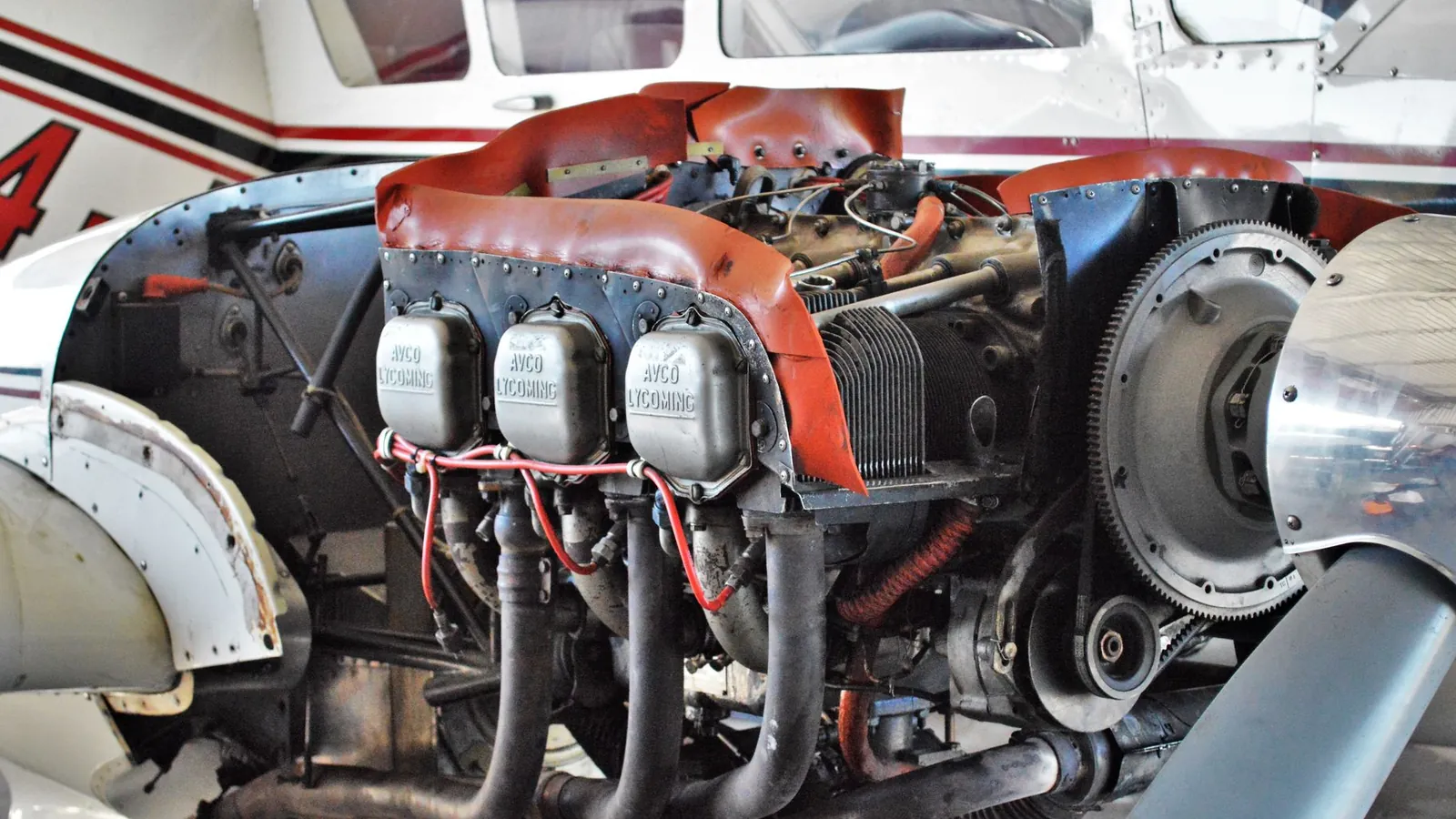
Airframe mechanics work on the aircraft's structure and systems. Powerplant mechanics work on engines and propellers. The FAA issues one mechanic certificate that can carry either rating or both, and holding both is what mechanics call the A&P. Most schools teach both together: 156 of the 204 open FAA-approved schools list both ratings, and the FAA estimates 18 to 24 months to finish.
Airframe vs. Powerplant: What Each Rating Covers
The FAA tests each rating on its own. The Airframe test draws on 15 subject areas, from metallic structures to water and waste systems. The Powerplant test draws on 13, from reciprocating engines to propellers. Both ratings share the General test, which runs 12 areas from electricity and electronics through human factors.
| Topic | Airframe | Powerplant |
|---|---|---|
| Works on | Structure, flight controls, landing gear, and the systems around them | Engines, propellers, and the systems that serve them |
| FAA test subject areas | 15 | 13 |
| Sample test topics | Metallic structures, hydraulics, fuel systems, electrical systems, rotorcraft fundamentals | Reciprocating engines, turbine engines, ignition and starting, propellers |
| Return to service | An airframe and any related part or appliance | A powerplant or propeller and any related part or appliance |
| 100-hour inspection (Part 91) | On an airframe | On a powerplant or propeller |
| Experience if you skip school | 18 months for the rating alone | 18 months for the rating alone |
What an Airframe Mechanic Works On
Airframe covers the aircraft around the engine. The FAA's test standards list flight controls, landing gear, hydraulic and pneumatic systems, fuel systems, electrical systems, environmental systems, and ice and rain control, along with metallic and non-metallic structures. Rotorcraft fundamentals sit in the Airframe test too.
With the rating, you can approve an airframe or a related part or appliance for return to service after you perform, supervise, or inspect the work. You can also do the 100-hour inspection Part 91 requires on an airframe. Major repairs and major alterations are excluded.
The FAA also lets certified airframe mechanics work on avionics equipment. It issues no avionics-specific mechanic certificate, so avionics work comes down to training and the right tools.
What a Powerplant Mechanic Works On
Powerplant is the engine and propeller side. Its test subject areas include reciprocating engines, turbine engines, ignition and starting systems, fuel metering, lubrication, exhaust and reverser systems, and propellers.
With the rating, you can approve a powerplant or propeller, or a related part or appliance, for return to service after you perform, supervise, or inspect the work. The same 100-hour inspection authority applies to a powerplant or propeller. Major repairs and major alterations are excluded.
Can You Work With Just One Rating?
Yes. The FAA says there is no requirement to obtain both. What changes is your sign-off authority: Airframe covers the aircraft and its parts, Powerplant covers the engine and propeller, and neither reaches into the other. Holding both lets one certificate cover the whole aircraft.
Both ratings also open a door that one can't. An Inspection Authorization requires a certificate with Airframe and Powerplant ratings, each in effect for at least 3 years. The Inspection Authorization guide covers what comes next.
If you earn the certificate through work experience instead of school, the clock is shorter than double. One rating takes 18 months of practical experience. Both take 30 months of concurrent experience, so the second rating adds 12 months, not another 18. The FAA allows nothing shorter, and an aircraft mechanic apprenticeship is one way to log the time.
How Schools Split the Two Ratings
Of the 204 open college-level FAA-approved schools, 156 list both ratings in one program (156 ÷ 204 = 76%). 10 list a program for the Airframe rating alone, and 7 of those are in Florida, where several technical and state colleges teach Powerplant as its own program on the same campus.
| School | Airframe Program | Powerplant |
|---|---|---|
| Northwest Florida State College | 15 months, clock hour program | Separate Powerplant certificate |
| Lively Technical College | 1,350 clock hours | Separate 810-hour program |
| Charlotte Technical College | 1,350 hours | Separate day and evening programs |
| George T. Baker Aviation Technical College | 1,350 hours | Separate program on the same campus |
| Atlanta Technical College | Three semesters | Separate Powerplant certificate |
Lively Technical College in Tallahassee shows how the split works. Its Airframe program runs 1,350 clock hours. Students who want Powerplant enroll in a separate 810-hour program, listed at $3,105.83 in tuition, fees, and the textbook kit.
At Atlanta Technical College, students who already hold a Powerplant rating don't repeat the General portion. Pairing programs this way lets you start with one rating and add the other without starting over.
Which Rating Should You Start With?
If you're enrolling at a school, pick a program that teaches both. It's the standard design, it ends with one completion document, and the FAA estimates 18 to 24 months for most schools. Published program lengths are in the aviation maintenance school length guide.
A single-rating program can still be the right call if it's the one near you or the one you can afford first. You can add the second rating later by meeting its experience rule and passing its tests within 24 calendar months. The FAA issued 6,336 additional mechanic ratings in 2025, so plenty of mechanics do. The mechanic license guide covers the full requirements.
Pay for Airframe and Powerplant Mechanics
The BLS groups both ratings under one occupation, Aircraft Mechanics and Service Technicians. In May 2025 the median was $79,870, and 138,090 people held those jobs. The middle half earned between $62,630 and $99,130.
Where you land depends on employer, shift, location, and experience. The aircraft mechanic salary page breaks pay out by state, metro, and industry. For hiring demand, see is there an aircraft mechanic shortage.
Frequently Asked Questions
What Is the Difference Between Airframe and Powerplant?
Can You Be an Aircraft Mechanic With Only an Airframe Rating?
Do You Take the Airframe and Powerplant Tests Together?
Can You Add the Second Rating Later?
Do Airframe Mechanics Work on Avionics?
How Many Schools Teach Both Ratings?
Sources
- FAA - Become an Aviation Mechanic
- eCFR 14 CFR Part 65, Subpart D (Mechanics) - current as of Sept 18, 2026 issue
- FAA-S-ACS-1, Aviation Mechanic General, Airframe, and Powerplant Airman Certification Standards
- FAA - Experience Requirements to Become an Aircraft Mechanic
- FAA - How to Become an Aviation Maintenance or Avionics Technician
- FAA U.S. Civil Airmen Statistics 2025 (2025_Active_Civil_Airmen_Statistics_FINAL.xlsx)
- FAA AV-Info Part 147 school records
- Occupational Employment and Wage Statistics, May 2025 (49-3011)
- Aviation Airframe Mechanics
- Aviation Airframe Mechanics
- Aviation Maintenance Airframe Technical Certificate FAQs
- Aviation Airframe Mechanics
- Aviation Airframe Mechanics