
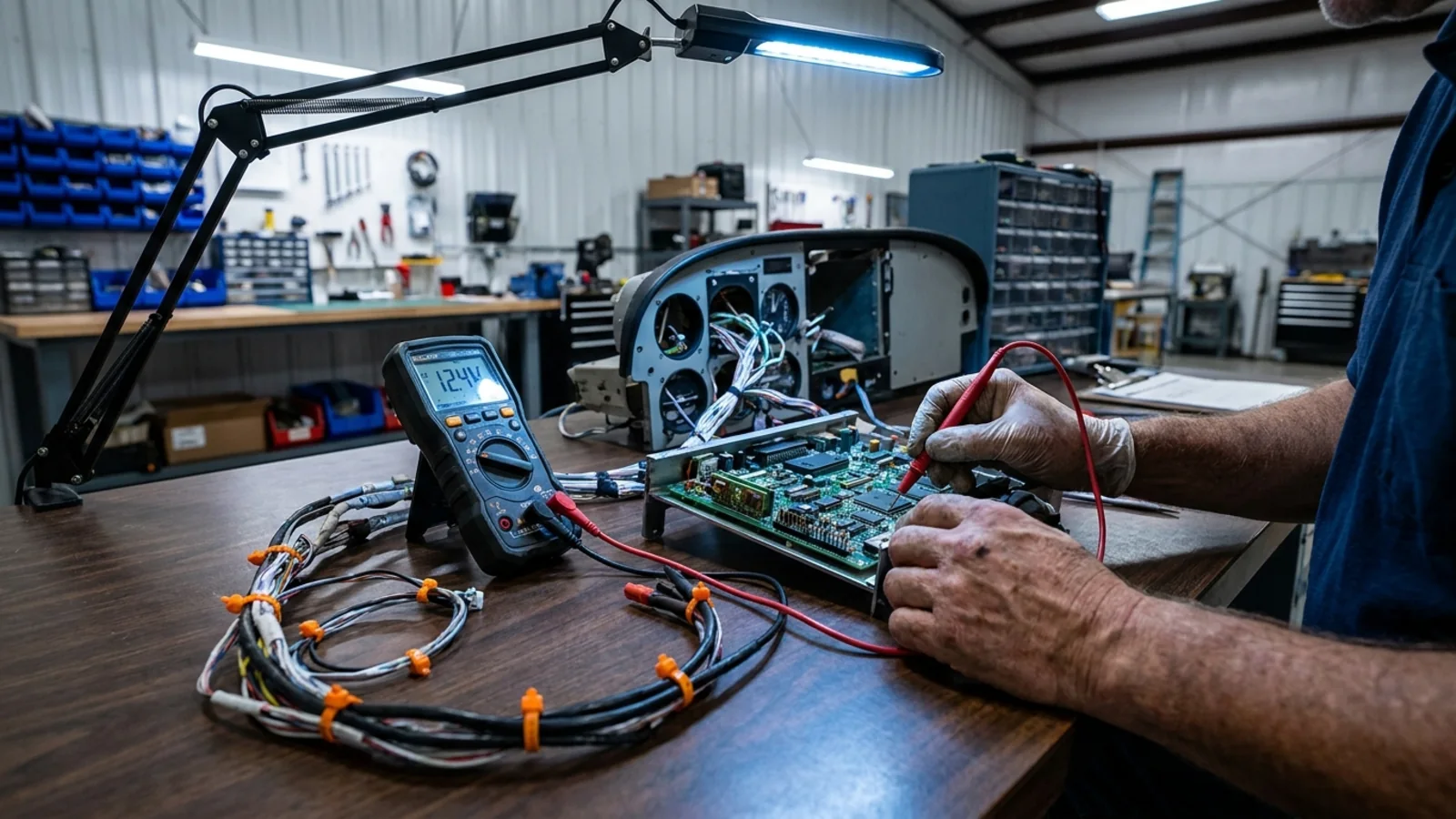
An avionics technician installs, tests, and repairs the electronics on aircraft: radios, navigation, radar, and flight instruments. The BLS counted 18,830 avionics technicians in May 2025, earning a median $82,280 a year. The FAA issues no avionics-only certificate, so technicians train at FAA-approved (Part 147) schools, in the military, or on the job.
This avionics technician profile walks through the work itself, the schools that teach it, the two credentials built around radio and aircraft electronics, and the federal pay and job data, with every figure sourced.
What Is Avionics?
Avionics is short for aviation electronics. The Pittsburgh Institute of Aeronautics, an FAA-approved school, describes it as the electrical systems behind an aircraft's communication, navigation, flight control, and monitoring functions. In practice that means radios, GPS and navigation gear, weather radar, autopilot, and the flight deck displays pilots read.
O*NET, the Department of Labor's occupation database, defines the avionics technician the same way: someone who installs, inspects, tests, adjusts, or repairs avionics equipment such as radar, radio, navigation, and missile control systems in aircraft or space vehicles. So the job reaches past airliners into military and space hardware.
You'll see the same job posted under different names. O*NET's sample titles include avionics installer, avionics line technician, avionics repair technician, aviation electronics technician, and aircraft electrical systems specialist.
What Does an Avionics Technician Do?
O*NET ranks each task by how important workers rate it. These are the core tasks for an avionics technician, highest rated first:
- Adjust, repair, or replace malfunctioning components, using hand tools or soldering irons.
- Lay out installations of aircraft systems from blueprints, manuals, and wiring diagrams.
- Keep records of maintenance and repair work.
- Test and troubleshoot instruments and assemblies with circuit testers, oscilloscopes, or voltmeters.
- Connect components such as radio systems, instruments, magnetos, and inverters.
- Coordinate with engineers, technicians, and other maintenance personnel.
- Run ground support and test equipment for functional tests, and read flight test data to find faults.
Notice where the paperwork lands. Keeping maintenance records scores as high as troubleshooting in O*NET's ratings. O*NET also added a newer task: installing, testing, and repairing avionics in uncrewed aircraft such as drones.
The FAA expects the work to lean further into computing. It says a strong background in computer hardware, software, databases, integration, and networking will be essential for future avionics systems.
Avionics Technician vs. Aircraft Mechanic
The BLS tracks avionics technicians and aircraft mechanics as two separate occupations. Here's how they compare on the federal data:
| Measure | Avionics Technician | Aircraft Mechanic |
|---|---|---|
| BLS occupation code | 49-2091 | 49-3011 |
| Employment, May 2025 | 18,830 | 138,090 |
| Median annual wage | $82,280 | $79,870 |
| 90th percentile wage | $113,680 | $128,890 |
| Projected growth, 2024-2034 | 7.9% | 4% |
| Average openings per year | 1,800 | 11,300 |
The FAA doesn't split the jobs that way. It issues one mechanic certificate with an Airframe rating, a Powerplant rating, or both, and it doesn't issue specialist ratings such as electronics specialist. The FAA allows certificated airframe mechanics to work on avionics equipment and says no additional regulatory certification is required for avionics work. Our mechanic license guide covers the ratings in detail.
There are limits. Without a mechanic or repairman certificate, you can only do that work under the supervision of a certificated mechanic. And even a mechanic with both ratings can't repair or alter instruments, because 14 CFR 65.81 excludes that work from mechanic privileges.
How to Become an Avionics Technician
There's no single required path. The FAA says many avionics technicians get their experience through military training, a technical school, or working for an avionics manufacturer. Here's the school route, step by step. For the service route, see our guide to becoming a military aircraft mechanic, and for earn-while-you-learn options, the aircraft mechanic apprenticeship guide.
-
Finish High School or the GED
The FAA says most FAA-approved schools require a high school diploma or a passing GED score before you enroll.
-
Train at an FAA-Approved School
The FAA puts most FAA-approved programs at 18 to 24 months, depending on the ratings you pursue. Pick one that teaches avionics.
-
Earn Your Airframe Rating
Pass the FAA written, oral, and practical tests. The FAA allows airframe-rated mechanics to work on avionics equipment.
-
Add the FCC GROL and NCATT AET
The GROL covers radio repair theory. The AET covers aircraft electronics, and NCATT exams are open to anyone.
-
Start Work as an Avionics Technician
Aerospace manufacturers and air transportation support companies employ the most avionics technicians, per the BLS.
The full certification process is laid out in how to become an aircraft mechanic.
Avionics Technician Schools and Training
Workers surveyed by O*NET point to a certificate as the usual entry credential: 50% said new hires need a post-secondary certificate, 16% said an associate's degree, and 18% said a high school diploma. The FAA notes that its approved schools award degrees in avionics, aviation technology, or aviation maintenance management. Compare those options in our aviation maintenance degree guide.
Of the 225 FAA-approved schools in our directory, 22 describe avionics training on their own program pages. That ranges from one avionics course inside the mechanic curriculum to a separate avionics program on the same campus. Some examples, as each school describes it:
- George T. Baker Aviation Technical College (Miami, FL): a separate Avionics Systems Technician program on the same campus as its airframe program.
- South Georgia Technical College (Americus, GA): a separate Avionics Maintenance Technology Diploma.
- Orange Coast College (Costa Mesa, CA): Airframe, Powerplant, Avionics, and Helicopter tracks.
- Kansas State University Salina (Salina, KS): an avionics electronics technology certificate that is NCATT certified.
- Metro Technology Centers (Oklahoma City, OK): Aircraft Electronics Technician (AET) certification available alongside the AMT program.
- Embry-Riddle Aeronautical University (Daytona Beach, FL): an Avionics Line Maintenance minor, with the FCC GROL and NCATT AET listed as additional credentials.
- US Aviation Academy Denton (Denton, TX): an optional 4-week, full-time avionics add-on for $4,000.
- Southern Utah University (Cedar City, UT): an avionics certificate you can earn alongside the AMT program.
- Southern Illinois University Carbondale (Murphysboro, IL): an Aviation Electronics (Avionics) specialization.
Florida has the most avionics technician schools on that list, with 3 of the 22. Browse aviation maintenance schools in Florida or the full school directory. Before you commit, check what aircraft mechanic school costs and how long it takes. Hands-on shop hours mean online aircraft mechanic school covers only part of the training.
Avionics Technician Certification: FCC GROL and NCATT AET
The FCC General Radiotelephone Operator License (GROL) requires passing written Elements 1 and 3. Element 3 covers the electronics needed to adjust, repair, and maintain radio transmitters and receivers in the aviation and maritime radio services. The GROL is normally valid for life. Adding the Ship Radar Endorsement takes one more written exam, Element 8.

The NCATT Aircraft Electronics Technician (AET) certification, run by ASTM International, is a 90-question exam with a 73% passing score. It's open to anyone, whatever your training or experience. After you pass the AET, you can add endorsements in installation, navigation, communication, and onboard safety systems. NCATT certifications renew every five years.
| Credential | Issued By | Exam |
|---|---|---|
| General Radiotelephone Operator License (GROL) | FCC | Written Elements 1 and 3 |
| Ship Radar Endorsement | FCC | Written Element 8, added to a GROL |
| Aircraft Electronics Technician (AET) | ASTM International (NCATT) | 90 questions, 73% to pass |
| AET endorsements (AEIT, ANS, DNS, OCS, RCS) | ASTM International (NCATT) | 50 to 106 questions, 70% to pass |
Neither credential replaces an FAA certificate, and the FAA doesn't require either one. The full breakdown is in our avionics certifications guide.
Avionics Technician Salary
Half of avionics technicians earned more than $82,280 in May 2025 and half earned less. The bottom 10% earned under $49,410, the top 10% more than $113,680, and the hourly median was $39.56.
Industry moves the number more than anything else in the BLS data. Scheduled airlines paid avionics technicians a median $109,300, while support activities for air transportation paid $72,790. That's a $36,510 gap ($109,300 minus $72,790).
State and metro pay, plus the airline figures, are on the avionics technician salary page and the airline mechanic salary page.
Avionics Technician Job Outlook
Avionics technician projections, 2024-2034
Jobs in 2024
21,400
Projected 2034
23,100
Growth
7.9%
Openings per Year
1,800
Projections Central
Projections Central expects avionics technician employment to grow from 21,400 in 2024 to 23,100 in 2034, an increase of 1,700 jobs or 7.9%. That's nearly double the 4% growth projected for aircraft mechanics over the same years. The projections use their own employment base, which is why the 2024 figure differs from the OEWS count of 18,830.
Growth alone adds about 170 jobs a year (1,700 over ten years). The rest of the 1,800 average annual openings come from replacing workers who leave the occupation. Among states with at least 1,000 avionics technician jobs in 2024, Alabama (20%) and Florida (17.2%) have the fastest projected growth.
For the broader picture, read is aircraft mechanic a good career.
Where Avionics Technician Jobs Are
Most avionics technicians don't work for airlines. The BLS counted 7,100 in aerospace product and parts manufacturing and 5,880 in support activities for air transportation. Together that's 12,980 of 18,830, or 68.9%.
| Industry | Jobs | Share of All Jobs | Median Wage |
|---|---|---|---|
| Aerospace Product and Parts Manufacturing | 7,100 | 37.7% | $90,720 |
| Support Activities for Air Transportation | 5,880 | 31.2% | $72,790 |
| Air Transportation (Airlines and Charter) | 1,460 | 7.8% | $99,620 |
| Federal Executive Branch | 1,090 | 5.8% | $72,630 |
| Engineering Services | 1,070 | 5.7% | $85,390 |
The jobs also cluster by state. Washington alone had 3,400 avionics technician jobs, 18.1% of the national total, and the five largest states held 10,550, or 56%. If you live far from these hubs, plan on relocating or commuting for avionics technician jobs.
| State | Jobs, May 2025 | Median Wage | Growth, 2024-2034 |
|---|---|---|---|
| Washington | 3,400 | $91,380 | 7.9% |
| Florida | 2,400 | $83,800 | 17.2% |
| Georgia | 1,820 | $79,060 | 11.7% |
| Texas | 1,710 | $81,950 | 12.9% |
| California | 1,220 | $92,480 | 8.3% |
| Alabama | 910 | $95,920 | 20% |
Schools near those hubs: Washington aircraft mechanic schools, Florida aircraft mechanic schools, Georgia aircraft mechanic schools, Texas aircraft mechanic schools, California aircraft mechanic schools, Alabama aircraft mechanic schools. For hiring patterns across the whole maintenance field, see aircraft mechanic jobs.
Frequently Asked Questions
What Is Avionics?
What Does an Avionics Technician Do?
How Long Is Avionics Tech School?
Do Avionics Technicians Need an A&P License?
How Much Does an Avionics Technician Make?
Is Avionics Technician a Good Career?
Sources
- Avionics Technicians (49-2091), Occupational Employment and Wages, May 2025
- Aircraft Mechanics and Service Technicians (49-3011), Occupational Employment and Wages, May 2025
- Long-Term Occupational Projections 2024-2034: Avionics Technicians
- 49-2091.00 Avionics Technicians
- How to Become an Aviation Maintenance or Avionics Technician
- Become an Aviation Mechanic
- Experience Requirements to Become an Aircraft Mechanic
- 14 CFR Part 65, Subpart D (Mechanics)
- 14 CFR Part 65, Subpart E (Repairmen)
- 47 CFR Part 13 (Commercial Radio Operators)
- NCATT Certification Program
- FAA Recognizes AET Certificate as Equal to Formal Training
- What Is an Aviation Electronics Technician (AET)?
- FAA AV-Info Part 147 school records
All sources retrieved .
How we gather and check school and wage data is explained in our data methodology.